Where Are They?
Dear creator God, life giver, I've been hearing all about a view,
One that's upheld by so many Christians who believe that it is true.
It says that a Christian goes straight to Heaven the moment that they die,
Yet, when I study Your Holy Word, Lord, such a view I cannot buy.
No, I can’t imagine Lazarus (who lay dead for four earthly days),
Being summoned back to earth from Heaven so that You could him then raise,
For such would surely be unfair, and it seems ridiculous as well,
And it even more confusing if he had been burning in some Hell.
Your Holy Word tells us, Lord, that David who repented in his heart,
Is still buried here in the ground and that he didn’t from Earth depart;
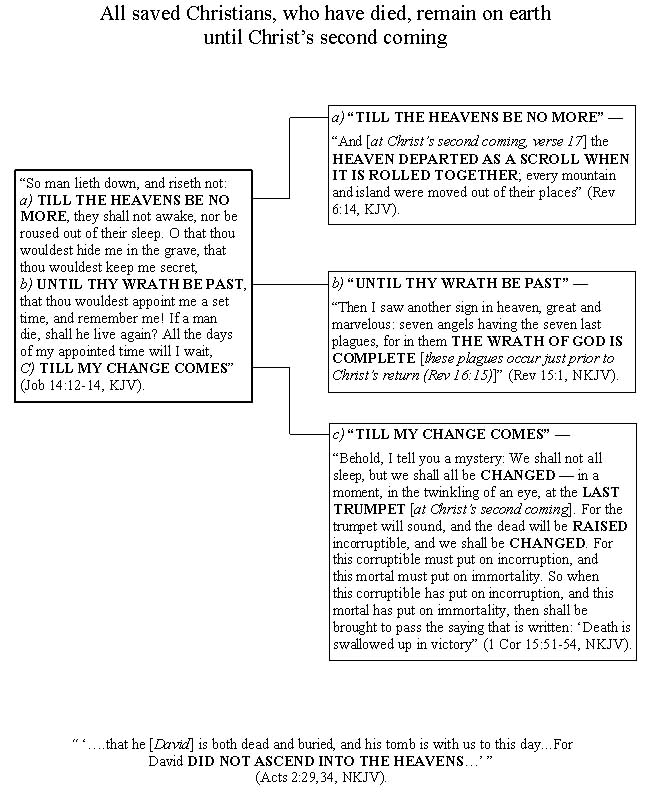
And that the dead know nothing at all, and (metaphorically) sleep
Until Your second coming when You then divide the goats from the sheep.
And Your Good Word also tells us that every sleeping saint “will hear”
Your loud awakening command when with clouds of angels You appear.
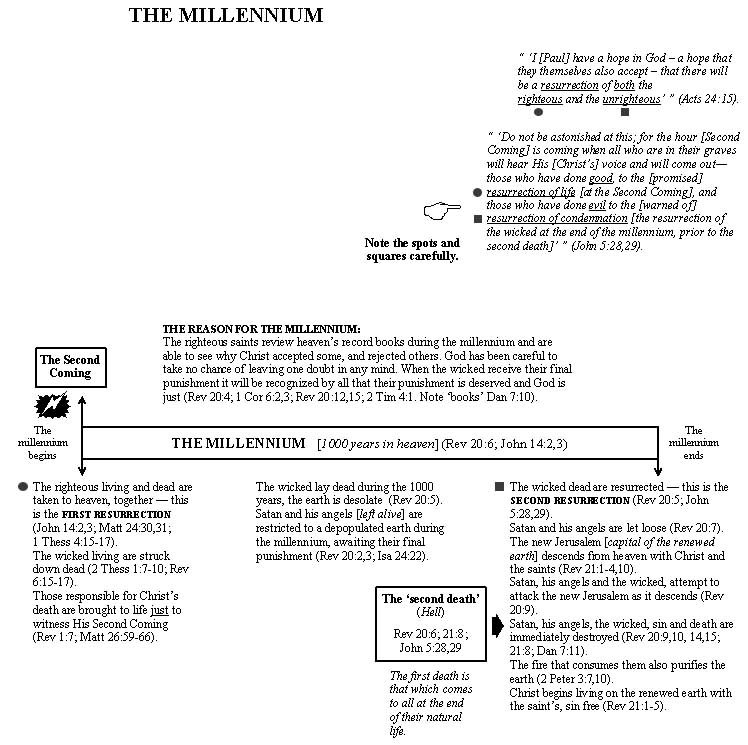
And that only then — these saints on rising — ascend to Heaven with You,
And not upon their natural death as so many folk think they do.
No, You don’t act unfairly, Lord, such favouritism You don’t show,
But instead, treat everyone the same knowing that's the way to go.
Therefore, the saints of all the ages, immortality don’t obtain
Until they're all gathered up together when You come to Your own claim.
Your Word says that You will be bringing their reward with You (on that day),
In other words, that it's at Your second coming that such You'll repay.
And it also states that it's only then that the saints their crowns receive,
Which shows that the saints cannot be up there if Scripture we're to believe.
You say that up in Heaven there are homes that You have been preparing
For those ones that You will come to claim at Your glorious appearing.
Now, if they already occupy these homes (as some folk think is true),
Then coming back to get them would be a very pointless thing to do.
Many say that their departed one has gone to Heaven, even Hell!
But despite where anyone might go, such is dependent on Your will,
For only You, Lord, can read one's life — yes, only You who judges, knows,
So, what right has anyone to think that they know that place that You chose.
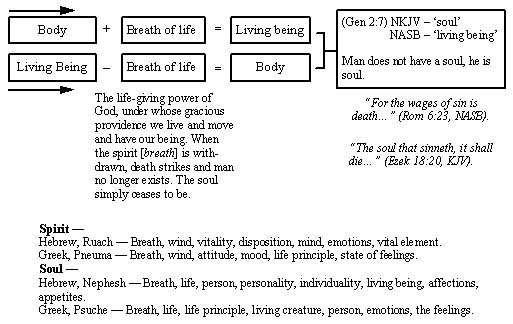
Many also think that from the body a ‘soul’ at one's death departs,
Continuing on wherever — that is, without its bodily parts.
But in those words that are translated as “soul,” there’s nothing that implies
That a conscious entity of some sort leaves the body when one dies.
Intriguingly, Your Word says, Lord, that the “soul” that sins will surely die,
Yet, the devil, as he did with Eve, tries to tell us that’s just a lie.
Plus, Your Word also tells us that those who stop a sinner from straying
Will save that “soul” from dying, which is most unlike what Satan’s saying.
But of course that “soul” is just us, and not some separate entity,
For once Your “breath of life” has gone from us, we simply cease to be.
Yes, often “spirit,” “soul” and “body” are just figuratively used,
And hence why there's a need of caution here, lest they somehow be misused.
Well, I’m so glad that You, my Lord, have my blueprint safely in Your care,
And that You — the creator of this earth — can make dead saints reappear.
Thus, may it be that at Your coming, immortality I'll receive
Along with all the others also, who this sad old world, then, will leave.
By Lance Landall
This poem was upgraded on the 8 May 2016.
The
idea of an immortal soul and an immediate afterlife originated in the
ancient pagan religions and philosophical systems of Greece and Egypt.
This pagan belief is the cornerstone of almost all eastern religions
and the new age movement. This pagan belief became established as a
Christian precept via Greek influence.
The
theories of Plato (b428 - d347 BC) heavily affected Western
Civilization, including Christianity, (especially in the Latin West).
Plato claimed there was an immortal and spiritual soul, which was said
to exist prior to, and as separate from, the material body.
The
theory of the immortality of the soul was one of those false doctrines
that Rome, borrowing from paganism, incorporated into the religion of
Christendom. Martin Luther classed it with the "monstrous fables that
form part of the Roman dunghill of decretals."
E. Petavel, The Problem of Immortality, page 255.
This poem was penned 'round the same time as the war in Ukraine.
2. Mum's Looking Down And Smiling
Well, so their belief goes, misinterpretation and lack of logic at play,
Yes, they not having thought things out well, and why towards the ludicrous they stray.
Well, I mean to say, should any loved one be looking down, just what might they see
If their family member lives in Ukraine, or where other such ills might be?
They clearly not smiling given the hell that many are going through, sadly,
And thus that loved one, who's supposedly in Heaven, hurting really badly.
Yes, feeling helpless, yet there with God who could stop such, and who’s letting them see
Loved ones murdered, tortured, bashed, raped and so on; and thus He acting thoughtlessly.
No, there’d be no joy in Heaven if such were true, and why we all have to wait,
No one getting there before us, and thus in the meantime, a shut golden gate.
A gate that will open when Christ returns to Heaven from having rescued us,
We all sharing that same joy TOGETHER, ’cause there’s no one fairer than Jesus.
He hardly wanting us having sleepless nights in Heaven, anxious days and years,
And this why He’ll deal with those deceiving mediums who play on people’s fears.
“Oh, where’s my loved one? What have they got to say to me?” NOTHING, nothing at all,
They still here on Earth, and here will stay, until that coming resurrection call.
And so, Mum’s not looking down and smiling, even at something she could smile at,
Anything to do with her having gone no further than Earth’s turf, thus can’t chat.
Not to you nor a medium, she dead body and soul, the breath of life gone,
And all who dare say otherwise, the very Words of Christ himself, set upon.
By Lance Landall
“...and after that He said to them, ‘Our friend Lazarus sleeps…’ However, Jesus spoke of his [Lazarus’] death…” (John 11:11,13, NKJV).
If Lazarus had gone to Heaven, Christ would hardly have said that he's sleeping.
"...that he [David] both died and was buried and his tomb is with us today...For David did not ascend into the heavens.." (Acts 2:29,34, ESV).
“And all these [faithful Bible heroes of all the ages], though commended through their faith, did not receive what was promised [eternal life, immortality], since God had provided something better [much fairer] for us, that apart from us they should not be made perfect [immortal. They will have to wait]” (Heb 11:39,40, ESV).
3. It Not Making Sense
Heaven? No, not in our fallen, cluttered universe, but millions of miles away,
And thus loved ones supposedly up there hardly looking down on us; such astray.
Yes, hardly so, unless they’re accessing Zoom on their laptop, but on it all day?
Or using incredible binoculars, but then, grey clouds getting in the way.
No, it not making sense, nor fallen mediums with their messages — lies, simply,
Unless our loved ones are checking their emails, but who us, would contact directly.
There no need of mediums, and they sinners too, hardly worthy agents, and thus
Simply pawns of the devil, and who have well and truly been condemned by Jesus.
Yes, if anyone had messages for us, it would be unfallen angels, who
Wouldn’t charge, nor ask questions, ’cause they’d already know things; no probing ballyhoo.
Oh, the silliness of it all, our loved ones not up there, and nor able to see,
And praise God they can’t — snoozing the slumber of death — ’cause such would spoil the heavenly.
No,
There’s no contact going either way come deceased loved ones, no communication,
Only the Spirit speaking to us, or angels, given some situation.
A message from God, perhaps, but not deceased loved ones, all why Christ’s coming back,
Hence that resurrection day, the dead rising first, ’cause only Christ death’s code can crack.
And which means no one’s looking down either via this means or that means, to be clear,
And even if they were up there, we quarantined, unable to taint or smear.
God not allowing their peace to be spoilt, their heavenly happiness and joy,
But they aren’t up there, either looking or speaking, hence that soon ascending convoy.
By Lance Landall
4. That Trumpet Blast And Shout
It’s clear the dead haven’t gone anywhere if it takes a trumpet to wake them.
No, they can only awaken if they’re here, not up in Heaven, or elsewhere.
The dead rising first, then us, we all caught up together to meet Jesus,
And so, as far as the dead go, Christ’s currently also building homes for them.
If a soul had departed from their body, how would the body hear the shout,
Which, only the dead in Christ need to hear, so that they’ll awaken and come out.
Their grave no longer holding them, the giver of the breath of life having come,
And therefore, those harps provided up in Heaven, they will be able to strum.
Those of us still alive able to see Christ coming, but not those in their graves,
Hence why they have to be awakened, and hence those soon ascending human waves.
Both the dead in Christ and the living who’re saved caught up together in the air,
On that glorious coming resurrection day, which together, we’ll all share.
After all, Christ would hardly just resurrect bodies, or should I say just bones,
Many humans having been annihilated given those dreadful war zones.
No, Christ’s coming for the complete person, and why, in the twinkling of an eye,
They’ll be remade, given immortality, as upward to Heaven too, they fly.
And this why all the saved of all the ages will have to wait for that blast and shout,
Christ’s arrival surprising most, who’re still caught up in their busyness or doubt.
Though alive at His coming, their scoffs or sinful indulgence catching them out,
Like a thief in the night, who likewise, might blast on a trumpet and give a shout.
That thief's intention to scare, but not Christ, His blast and shout bringing life and joy,
The dead rising first, then the saved who’re still alive; a heavenly bound convoy.
None of us already up there, ’cause that would be unfair, and why soon we’ll hear,
An exciting trumpet blast and shout, and then immorality we’ll share.
Yes, that trumpet blast and shout is what it’s all about, ’cause Scripture tells us so,
No soul flitting to Heaven beforehand, death kind of like a sleep, knockout blow.
And hence that wake up call, that signal Christ has arrived, that trumpet blast and shout,
That rousing return of Jesus that the Word of God has warned us all about.
By Lance Landall
5. Surely Enough Said
Imagine if the dead were alive and we able to speak to them somehow,
And perhaps we saying, “It’s alright for you, you’re not the ones suffering.” WOW!
Yes, pretty rough stuff, we having it tough, and resenting still being down here,
Which is why no one’s up there, and why even Scripture says that such wouldn’t be fair.
Yes, we all having to wait ’till Christ’s coming, and thus the dead kind of sleeping,
No loved ones up in Heaven pulling back the curtain and anxiously peeping.
They worried about how we’re getting on, even terribly upset to see
Miseries and hassles that may see us fall and miss out on eternity.
No, not good for them, not good for us, all why God would hardly do things that way,
And hasn’t done, and hence His pointing to that glorious resurrection day.
A day when we’ll all be ascending together, the saved dead having been dead,
And not copping complaints and wails from us who’re still stuck here — surely enough said.
Yes, some having been up there thousands of years before us, or maybe forty,
We doing it harder if living longer, Earth full of the evil and naughty.
Those others up in Heaven having a ball, Christ there in person, but not here,
And how much would that say about His love and care, being impartial and fair?
And why the dead are still dead — surely enough said.
So much for the wedding banquet, half the bride already up there, and how long?
And still waiting; the other half of the bride that coming resurrection throng.
They waiting too, it all sounding like public transport, head office in a spin,
But so the story’s spun, a Greek one, that as far as God goes, must’ve worn thin.
Yes, surely enough said.
By Lance Landall
“And all these [faithful Bible heroes of all the ages], though commended through their faith, did not receive what was promised [eternal life, immortality], since God had provided something better [much fairer] for us, that apart from us they should not be made perfect [immortal. They will have to wait]” (Heb 11:39,40, ESV).
6. Christ Won't Be Back Tomorrow
No, Christ won’t be back tomorrow, and nor any other date that man has set,
But sometime very soon, though when, even Christ himself doesn't know, don’t forget.
’Cause that’s what Scripture says, and if Christ doesn’t know, nor do we, obviously,
Given that we’d hardly have the drop on Him, and thus it’s a secret, clearly.
Hence why we’ve been told to be ready in the sense of being right with Him, so,
We all need to get our act together, in other words, for when He does show.
We not to procrastinate, hold off, but be ready as if it’s tomorrow,
Lest we get caught out, and thereby, just like the devil, have much cause for sorrow.
Yes, God’s no fool, He knowing that giving a date wouldn’t be wise, but silly,
For many wouldn’t get their act together until the last minute, you see.
And meantime, their witness faulty, their wilful sinning hardly put behind, and,
They hardly genuine, but in step with that worldly, lukewarm and saltless band.
Yes, their last minute efforts much like those death bed confessions, such born of fear,
Not genuine repentance, and thus their entrance into Heaven hardly fair.
And as for the committed, those who’re ready and waiting — well, they’re told to endure,
Such proving their loyalty, their trust in God, and thus their eternal life sure.
Therefore, going by Scripture, any who say otherwise are false prophets, and,
Such we’ve been warned of, false messiahs too, for lies, signs and wonders, Satan’s planned.
Oh, how he loves to deceive, some secret rapture hardly biblical, you know,
For all will see Christ returning, He surprising most like those thieves in the night,
Oh,
But not the prepared though, who know Christ's return is the end of the world, and woe.
And they without fear, joyful at Christ’s return, His judgment having taken place,
His reward coming with Him, and punishment too, which only the wicked face.
Yes, the saved of the ages all gathered up together, and the wicked struck dead,
It all playing out exactly as Christ, His apostles and the Good Word said.
And there's another thing:
It appears that Christ’s coming has been delayed that more might be saved, and therefore,
How long that delay? Ops! For there goes man’s calculations, which all should ignore.
And that date being far too critical to leave in the hands of fallen men,
Who’d only fiddle, and who’re so prone to getting things wrong, time and time again.
But what about this text?
“But you, brethren, are not in darkness, that this day should overtake you like a thief.”
Oh, how folk get things mixed!
The reason that we’re not in darkness is, because we’ve been warned to be ready,
And thus we not caught out by that date that we haven’t been informed of, you see.
Hence it only the non-believers that will get caught out — well, hopefully so —
Because we’ve been warned, they scoffing at a second coming, for Christ they don’t know.
And believe me, Christ won’t come in secret, for the Scriptures make that very clear,
But rather, in spectacular style, and with lightning flashes, He’ll soon appear.
Yes, He surrounded by hosts of angels, and thus in great glory will be seen,
He descending from the heavens as His trumpet blast disturbs Earth’s final scene.
By Lance Landall
"And as He sat upon the mount of Olives, the disciples came unto Him privately, saying, 'Tell us, when shall these things be? and what shall be the sign of thy coming, and of the end of the world?' " (Matt 24:3, KJV).
“Look! He is coming with the clouds [angels]; EVERY EYE WILL SEE HIM, even those who pierced Him; and on His account all the tribes of the earth will wail [the remorse of the wicked]. So it is to be. Amen” (Rev 1:7).
“But
concerning that day or that hour, NO ONE KNOWS, not even the angels in
heaven, nor the Son, but only the Father" (Mark 13: 32, ESV).
“ ‘For FALSE CHRISTS AND FALSE PROPHETS WILL ARISE and will show GREAT SIGNS and WONDERS, so as to mislead, if possible, even the elect ’ ” (Matt 24:24, NASB).
“Here is a call for the endurance [faithfulness] of the saints, those who keep the commandments of God…” (Rev 14:12, ESV).
“And all these [faithful Bible heroes of all the ages], though commended through their faith, did not receive what was promised [eternal life, immortality], since God had provided something better [much fairer] for us, that apart from us they should not be made perfect [immortal. They will have to wait]” (Heb 11:39,40, ESV).
See my poem What Rapture? which is in the orange box that's under the
one you used to view these poems.
7. Fairness All Part Of God's Love
No, God’s not coming back for bodies, many blown to smithereens, and therefore,
Our Saviour is coming back for the complete person, just as they were before.
So, blueprint in hand, and with His supernatural ability, they’ll rise,
The dead first, then the living, and no one saying, “Here, try this body for size.”
No, God’s not coming back for smelly, rotting flesh, nor millions of pieces, and
He more than capable of redoing us, in an instant, and there we’ll stand.
The breath of life re-entering, not some soul, and off we’ll go to those homes above,
We all made perfect and immortal together, fairness all part of God’s love.
Oh where oh where have Christians got the strange idea from, that as soon as we die
It’s down into some cavernous, fiery Hell, or up to Heaven that we fly.
Such nothing but pagan in origin, and what is rightly termed heresy,
Just like that man-made, superimposed, spare us our cross, untrue rapture theory.
“Here’s a call for the endurance of the saints,” the Bible cries, no opting out,
We bearing that cross of ours right up until that time of Christ’s return, and shout.
No one having gone anywhere, up or down, every piece of them still here,
’Till that time when both the living and dead meet their Lord and Saviour in the air.
If Christ took Christians to Heaven at death, He’d take their bodies too, not just souls,
Because souls we are; thus that lone soul flitting to Heaven belief, full of holes.
All why God’s Word says the dead in Christ sleep — it meaning, that they’re dead to the world,
Until that coming, beautiful, prepared for, resurrection scene is beheld.
By Lance Landall
8. Are You Saying That Satan Didn't Lie?
If the saved go to Heaven at death (as most believe), then Satan didn’t lie,
’Cause he having said that they wouldn’t die, but Adam and Eve surely did die.
Otherwise, they would have simply passed over to the other side, and therefore,
Death not death at all, but a blink, as it were, just a whimper and not a roar.
And hence our hope, which is not that when we die we’ll go to Heaven, but in fact,
That Christ will be returning, and that coming resurrection (Satan’s attacked),
’Cause Christ is just returning for bodies, they say, which doesn’t make sense at all,
We all renewed and restored at Christ’s RETURN, that TRUMPET blast and eager CALL.
And therefore, Adam, Eve, and any Bible hero still here on Earth with us,
They not having got what was promised, we’re told, but like us, waiting for Jesus.
Yes, He’s bringing His reward WITH Him, we’re told, and Lazarus knowing this too,
’Cause Christ hardly brought him back from Heaven, and thus a parting soul hardly true.
Yes, if we went to Heaven at death, we’d only suffer ill health and old age,
We closing our eyes and entering Paradise, death hardly able to rage.
But rage it does, keeping us apart from Christ until His return, appearing,
When, with the saved dead rising first, having HEARD His call, Heaven we’ll be sharing.
Along with Adam and Eve.
That pair would’ve hardly gone to Heaven before Christ had died on Calvary,
Sin having necessitated a COMING and RETURNING Saviour, you see.
Paul WARNING of a coming JUDGEMENT, which PRECEDES any reward or penalty,
Thus none going to Heaven beforehand, grace not covering iniquity.
So, are you saying that Satan didn’t lie, that death has no sting, venom, say,
One simply getting up after, as large as life, just like Christ did one Sunday?
No, we waiting in the grave, or wherever, and why the Bible says one sleeps
(A metaphor), while over the faithful (dead or alive), a watchful eye God keeps.
Yes, buried or cremated, God knows where every particle is, but hey,
He has our blueprints (updated, expanded), and there’s that resurrection day!
We awakening as if it were yesterday, hence why it seems like a sleep,
Christ returning to take us to those mansions, a promise that He said He’d keep.
By Lance Landall
9. No One Can Exit Or Enter
We’ve been quarantined due to sin, are unable to leave our own galaxy,
Hence why we’re not allowed visitors from other galaxies, obviously.
They not having fallen, and thus our contamination a serious threat,
And this being why not a soul from another planet an Earthling has met.
Therefore,
Those UFOs folk have seen are no doubt engineered satellite holograms,
And Satan’s clever trickery designed to fool — yes, even Christ’s little lambs;
You and I, that is, because Satan and his mates are stuck in our galaxy,
And with nothing better to do than engage in trouble and chicanery.
So any aliens are simply disguised evil angels who’re aiding men,
Men who’re behind those holograms, that daft fantasy and science fiction pen.
It all creating a distracting curiosity, and misleading too,
Men not turning to the Word of God anymore, when there’s a greater need to.
Hence that warning of a coming “lawless one" with his signs and wonders, and hey,
Those UFOs playing their part; and maybe Satan disguised as Christ, one day.
So keep this in mind, those UFOs not from other planets, nor those green men,
Who’re nothing but the doing of the Father of Lies, and that deluded pen.
But men not beyond making UFOs, and there’s their own trickery, of course,
And don’t forget quadcopters, innocent or not, aiding Satan’s evil force.
And what other clever inventions of men might be involved? So please take care,
Because the territory of the devil is nothing but a trap and snare.
Meantime, no one can exit or enter our sin marred, quarantined galaxy,
Where Satan and his cohorts devilishly plot and plan Earth’s grand finale.
And midst it all,
No space probe finding life elsewhere, none at all, and should it near our galaxy’s end,
The unseen hand of God would stop it in its tracks, for oh, how it must offend.
So don’t be fooled by UFOs and aliens, ghostly apparitions too,
For they’re nothing but the work of Satan, or men who also evil pursue.
And NASA on a collision course with God, for God’s glory isn’t its end,
Nor those evil doings of the Usurper who loves to deceive and pretend.
In the beginning God created the heavens and Earth, the glory all His,
And thus He not to be upstaged by usurpers or any technical whiz.
So no matter how clever man gets, and no matter how busy Satan be,
Our Creator God will have the last say, and until He says differently,
All will remain restricted to this galaxy and fallen territory.
Hence why I wouldn’t waste time on those UFOs and little green men, ghosts too,
But put every ounce of energy into glorifying God who’s true.
Yes, He no angel disguised as an alien, no spook, maker of UFOs,
But the God of truth who’ll soon return in glory and deal with His and our foes.
Oh happy day! All those deceiving signs and wonders gone, the “lawless one" too,
Satan no longer able to lie, deceive, nor any of his motley crew.
Thus no more false miracles, no more earthly agents of Satan deceiving,
But love and truth combining, that heavenly healing balm of God relieving.
And God fair, logical and systematic, because,
When He returns, “the dead in Christ will rise first,” and then us, if still alive then,
And midst “the dead in Christ,” past Bible heroes, all those faithful women and men.
Thus no one leaving Earth until Christ returns, other than the odd exception,
Like Moses and Elijah, so mind that, “Our loved one’s in Heaven,” deception,
Because even David’s still here, His reward coming with Christ, who’ll soon appear.
By Lance Landall
“Has in these last days spoken to us by His Son, whom He has appointed heir of all things, through whom also He made the worlds” (Heb 1:2, NKJV).
“And no wonder! For Satan himself transforms himself into an angel of light”
(2 Cor 11:14, NKJV).
“And all these [faithful Bible heroes of all the ages], though commended through their faith, did not receive what was promised [eternal life, immortality], since God had provided something better [much fairer] for us, that apart from us they should not be made perfect [immortal. They will have to wait]” (Heb 11:39,40, ESV).
Meantime, no one exiting or entering.
“That
the wicked is reserved to the day of destruction? They shall be brought
forth to the day of wrath. Who shall declare his way to his face? And
who shall repay him what he hath done? Yet shall he be brought to the
grave, and shall remain in the tomb (Job 21:30-32, KJV).
"...that he [David] both died and was buried and his tomb is with us today...For David did not ascend into the heavens.." (Acts 2:29,34, ESV).
“ ‘In My Father’s house [in Heaven] are many mansions; if it were not so, I would have told you. I go to prepare a place for you [referring to when Christ ascended to Heaven after the cross]. And if I go and prepare a place for you, I will come again [the Second Coming] and [then] receive you to Myself; that where I am, there you may be also [that’s His reason for coming again]’ ” (John 14:2,3, NKJV).
“For the Lord himself shall descend from heaven with a shout, with the voice of the archangel, and with the trump of God: and the dead in Christ shall rise first” (1 Thess 4:16, KJV).
Meantime, no one exiting or entering.
10. Soul Sleep? No!
No! There’s no such thing, death being our end until that great resurrection day,
The dead rising first, and then us (the saved who’re still alive), up, up and away.
We heading to Heaven to those mansions that Christ has been preparing for us,
Our blueprints having been safely in the hands of our loving Saviour Jesus.
And so, we recreated, though still just the same you and I, but made anew,
Not having experienced some kind of soul sleep in the grave, ’cause that’s askew.
No, sleep being figurative speech, as if awakening to Christ’s return,
’Cause that’s how it'll seem (no soul having departed either, nor been seen to burn).
By Lance Landall
11. It's Simply A Parable
"The rich man and Lazarus" tale, is just that, a parable, not fact,
'Cause this statement that I am making here, by much evidence is backed.
Yes, such is nothing but a parable, 'cause nothing else it could be,
And hence why here we'll examine why it cannot be reality.
It says that when Lazarus died, that right then, he received his reward,
That is, that he received it well before “the judgment day of our Lord.”
It also tells us that when the rich man died, he received no reward,
And instead, was punished, and well before “the judgment day of our Lord.”
And yet, the Bible clearly tells us that one’s punishment or reward
Is received at Christ’s return — that's after “the judgment day of our Lord.”
Therefore, let me repeat that point again. One’s punishment or reward
Is received at Christ’s return — that’s after “the judgment day of our Lord.”
And such is true, for just take a look, as so many verses convey
That no one's punished or rewarded until after God’s judgment day.
For it's only after Christ has finished judging that He will return,
Thus, it's only at this soon appearing, that each one their fate will learn.
The parable also states that those who are in Heaven or some hell,
Can actually see each other. Now, can’t you just hear a loud bell?
For tell me, who would believe such error? Well, I certainly know who:
Pharisees influenced by Greek thought, from which such falsehood clearly grew.
You see, our Lord employed in this parable a number of details
Already accepted as fact by Pharisees, who Christ would assail.
In fact, it was only their derision that prompted this parable,
As they would often seek out our Saviour in order to Him thus grill.
Yes, it’s so hard to imagine how anyone could hold to such views,
But this is just what can happen when people God’s holy light refuse.
And such has ever been the case, that where truth is wrongly cast aside,
Either non-belief or some fiction, soon into that vacuum will glide.
Christ met people on their own ground, utilizing things that they believed
To thereby convey certain lessons whereby truth might then be received.
And quite often He used parables like this one that is mentioned here,
Employing things they’d understand, in order to misconceptions clear.
So, what was our Lord trying to convey to these hostile Pharisees,
Who were so sure of their own knowledge, and so impossible to please?
This: That each man and woman determines their eternal destiny
In this life — that is, before they die, for no second chance there will be!
The rich man in this parable that Christ mentioned, was clearly well aware
Of the fate that's awaiting all who show the same lack of thought and care.
And therefore, he had no excuse, and therefore, no second chance deserved,
As all throughout his life on earth, he had never our Master served.
By Lance Landall
“Saying
[the angel] with a loud voice, ‘Fear God and give glory to Him, for the
hour [the period] of His judgment HAS COME [in other words, is
currently in session, as He is bringing His reward with Him]...’ ” (Rev
14:7, NKJV).
“
‘For the Son of Man shall come [at His Second Coming] in the Glory of
His Father with His angels; and THEN He SHALL REWARD [with eternal life
or death] every man according to his works [see Matt 7:21]’ ” (Matt
16:27, KJV).
“
‘Behold, I am coming soon! My reward [either eternal life or death] IS
WITH ME [will be given then], and I will give to everyone according to
what he has done’ ” (Rev 22:12, NIV).
“Now
there is in store for me the crown of righteousness, which the Lord,
the righteous Judge, will award to me ON THAT DAY [the Second Coming] —
and not only to me, but also to all who have longed for His APPEARING”
(2 Tim 4:8, NIV). Note Luke 14:14; John 6:40; 14:2,3; 1 Thess 5:9, 10;
Heb 9:28.
“
‘WHEN the Son of Man comes in His glory [at the second coming], and all
the angels with Him, then He will sit on His glorious throne. All the
nations will be gathered before Him; and He will [then] SEPARATE THEM
[people] from one another, as the shepherd separates the sheep [the
righteous] from the goats [the wicked]’ ” (Matt 25:31,32, NASB).
“Yet
all these [faithful Bible heroes of all the ages] having gained
approval through their faith, DID NOT RECEIVE WHAT WAS PROMISED
[eternal life, immortality], because God had provided something better
[much fairer] for us, SO THAT APART FROM US THEY WOULD NOT BE MADE
PERFECT [be given immortality. They will have to wait]” (Heb 11:39,40,
NASB).
“
‘So man lies down and DOES NOT RISE. Until the heavens are no longer
[until the second coming], He will not awake nor be roused out of his
sleep [a metaphor for the waiting period between one’s death and the
resurrection of the saints at Christ’s second coming]’ ” (Job 14:12,
NASB). Note Ps 6:5; 104:29; 115:17; 146:4; Dan 12:2; 1 Tim 6:16.
“See,
the day is COMING [future], burning like an oven, when all the arrogant
and all evildoers will be STUBBLE; the day that comes shall BURN THEM
UP, says the Lord of hosts, so that it will leave them neither root nor
branch [total annihilation]. And you shall TREAD DOWN THE WICKED, for
they will be ASHES” (Mal 4:1,3).
“And
if by turning the cities of Sodom and Gomorrah to ashes He condemned
them to extinction and made them an EXAMPLE of what is coming to the
ungodly” (2 Peter 2:6).
“
‘But the cowardly, unbelieving, abominable, murderers, sexually
immoral, sorcerers, idolaters, and all liars shall have their part in
the lake which burns with fire and brimstone, which is the SECOND DEATH
[clearly then, the wicked aren’t in some hell after their natural death
— Acts 24:15; John 5:28,29; Matt 10:28; 2 Peter 3:7; Rev 20:14,15]’ ”
(Rev 21:8, NKJV).
12. The Witch Of Endor
Did Saul really see Samuel? No, it’s clear that Saul did not,
As evidence that proves this, we can very clearly spot.
So, let us take a look now, at the evidence that’s there,
For often we discover things aren’t quite as they appear.
The wording, “Samuel said to Saul,” is simply the writer’s way
Of describing to readers, events on that fateful day.
Yes, King Saul simply perceived it was Samuel that he’d heard,
Hence why certain translators have chosen that very word.
It couldn’t have been Samuel, for we’re told the dead can’t rise
’Till Christ at His appearing, “Come forth!” to each dead saint cries.
We have also been informed they metaphorically sleep
’Till Christ at His appearing separates the goats from sheep.
Tell me, why did Samuel appear from somewhere down below
If he were up in Heaven, as some wrongly teach is so?
If Samuel were in Heaven, “Tomorrow you’ll be with me,” would mean,
That dead saints and apostates share Heaven’s glorious scene.
Given Samuel’s in his grave, awaiting Christ’s, “Come forth!” call,
How could someone summon him to appear before King Saul?
Clearly an evil angel or the devil in disguise
Via the medium, and apparition, was just conveying lies.
God wouldn’t use a medium to communicate with Saul,
For such practices He forbids, as they simply Him appal.
If God wouldn’t answer Saul because of Saul’s wrongful acts,
He’d hardly use a medium to communicate more facts.
So, watch those apparitions, and those voices from the dead,
That Satan via mediums has often many misled.
He certainly misled Saul, and he’ll mislead you and I,
If his cunning deceit and lies we very foolishly buy.
By Lance Landall
“Do not turn to mediums or seek out spiritists, for you will be defiled by them. I am the Lord your God” (Lev 19:31, NIV).
“Then
Saul said to his servants, “Seek out for me a woman who is a medium, so
that I may inquire of her”...He said to her, “What is his form?” And
she said, “An old man is coming up, and he is wrapped with a robe.” And
Saul knew that it was Samuel, and he bowed with his face to the ground
and did homage”
(1 Sam 28:7,14, NASB; Read the whole chapter).
13. Immortal Souls?
Do we have an immortal soul? No, ’cause such a thing couldn’t possibly be,
And such thinking hardly biblical too, but simply pagan philosophy.
When we pass away, we’re stone dead, lock, stock and barrel — in other words, totally,
Humans being a soul, not having a soul, which makes far more sense, quite frankly.
And hence the common expression: “She’s a lovely soul” — meaning, human being;
Or “He’s a lovely soul,” 'cause a man (a male) is also a living being.
And thus a soul being the complete human being, not some separate entity
(And that view being purely and simply just Greek and Egyptian fantasy.
If we're mortals, which we are, we can’t have an immortal soul, obviously,
’Cause such would be but an oxymoron — yes, something that simply cannot be.
Such is simply trying to have it both ways, when we can’t, which God has said,
And therefore, when we die — that’s it — not one part of us lives on, but remains dead,
At least until the coming resurrection — in other words, Christ’s soon return,
Which is another thing that from the Word of God the receptive mind can learn.
And thus it only then that to Heaven the repentant quickly wing their way,
Only then that they receive immortality, and there with Jesus will stay.
If at death the repentant believer goes to Heaven, where's the penalty?
’Cause sin wouldn't be quite such a big deal, and nor Adam’s fall, effectively.
However, sin caused a separation, a separation that will remain,
Until Christ’s second coming, that is, when then, He will end death’s terrible reign.
So mind you don’t go misinterpreting — as so many Christians out there do —
Those texts where "soul" simply means being, or where “spirit” means breath, 'cause this is true.
“Soul” simply being an expression, one that wholly refers to you and I,
And not to some separate entity, that at death, up to Heaven will fly.
And the same applies to creatures also, 'cause Scripture classes them as souls too,
And hey, as for the souls of amoebae flitting to Heaven, who'd hold that view?
No, such is plain nonsense, ’cause they don’t have a soul, but in fact are a soul,
So please don't think a soul's a part of them, 'cause like us, it is them as a whole.
By Lance Landall
This poem was upgraded on 17 September 2022.
“It is He [God] alone who has immortality...” (1 Tim 6:16).
“The soul [person] that sinneth, it shall die…” (Ezek 18:20, KJV).
Note: Gen 3:4,24; John 8:44.
“You
should know that whoever brings back a sinner from wandering will save
the sinner’s soul [that person] from death...” (James 5:20).
“
‘Do not fear those who kill the body but cannot kill the soul [the
person, individual, who/what we are]; rather fear Him [Christ] who can
destroy both soul and body in hell [Hence the so-called ‘soul’ can’t be
immortal. Hell is the ‘second death’ (Rev 21:8) — the final destruction
of the wicked]’ ” (Matt 10:28).
The theory of
the immortality of the soul was one of those false doctrines that Rome,
borrowing from paganism, incorporated into the religion of Christendom.
Martin Luther classed it with the "monstrous fables that form part of
the Roman dunghill of decretals."
E. Petavel, The Problem of Immortality, page 255.
Eleven Commonly Misinterpreted Texts, Each With An Answer.
(More texts may be added as time etc permits, but those already covered serve as samples. Sources available)
“And Jesus said to him, ‘Assuredly, I say to you today, you will be with me in Paradise [Heaven. Jesus here, was speaking to the thief on the cross]” (Luke 23:43, NKJV).
Answer:
Notice that the comma in this text has been placed correctly [by me],
unlike the bias of the translators who put it this way: ‘Assuredly, I
say to you, today you will be with me in Paradise’. The comma, that has
been placed between the words ‘you’ and ‘today,’ was put there by the
translators. The original Greek text has no punctuation. After Christ
arose from the grave, He told Mary that he had not yet ascended to his
Father (John 20:17). He ascended to Heaven some time later. Therefore,
how could the thief have gone to be with Christ in heaven, immediately
after his death, when Christ himself hadn’t even gone to Heaven? Here
in Luke 23:43, Christ is clearly referring to the time when He will
return (John 14:1-3).
“He [Saul] said to her [the medium], “What is his appearance?” She said, “An old man is coming up; he is wrapped in a robe.” So Saul knew that it was Samuel, and he bowed with his face to the ground, and did obeisance” (1 Sam 28:14).
Answer:
1) “Knew” — Saul’s questions, together with the woman’s replies, are in
themselves evidence that Saul did not see Samuel. He “perceived” that
it was Samuel. The NKJ and KJ versions read “perceived.” If anything
was to be seen, it would have been a Satanic apparition.
2) “Why have you disturbed me by bringing me up” (verse 15) — If the
doctrine held by most Christians, that a righteous man ascends to
heaven at death, had been held in this ancient period, the summons
would have been to bring Samuel ‘down,’ not up.
3) The Lord would not have spoken to Saul by a medium, a practice He
had outlawed (Lev 20:27;19:31), after He had refused to communicate
with Saul by legitimate means (1 Sam 28:6).
4) If the spirits of the dead were disembodied souls, they obviously
would not need to be wrapped around with cloths (verse 14)
5) If the doctrine held by most Christians, that a righteous man
ascends to heaven at death, had been held in this ancient period,
“Tomorrow you and your son shall be with me” (verse 19) would mean that
God’s prophets and apostate kings share the same living quarters after
death.
6) “Samuel said to Saul” (verse 15) — This clause must not be
interpreted as meaning that it was actually Samuel who spoke. The
Writer simply describes events as they appeared, which is the normal
way in a narrative.
7) “Your enemy” (verse 16) — These words identify their author. Satan
has always endeavoured to paint the character of God in false colours,
as a revengeful tyrant. He depicts God to men as their enemy.
“And whoever lives and believes in me shall never die. Do you believe this?’ (John 11:26, NKJV).
Answer:
The reference here is clearly to the second death (Rev 21:8; 2:11;
20:6). From this experience those who live and believe in Jesus will be
delivered (Rev 20:6).
“...I saw under the alter the souls of those who had been slain for the word of God and for the testimony which they held. And they cried with a loud voice, saying, “How long, O Lord, holy and true, until you judge and avenge our blood on those who dwell on earth?” (Rev 6:9,10, NKJV).
Answer:
Here we have a ‘symbolic’ representation. This representation is simply
designed to reassure those who are facing martyrdom and death, that
ultimately, they will be vindicated by God. These martyrs may be
thought of as sacrifices presented to God, their blood shed on earth
poured symbolically at the heavenly altar (2 Tim 4:6; Phil 2:17), just
as the blood of sacrificed animals was poured at the base of the Old
Testament Hebrew sanctuary altar, the alter of burnt offerings (Lev
4:7,18,25,30) .
“And so it was, as her soul was departing (for she died), that she called his name Ben-Oni; but his father called him Benjamin (Gen 35:18, NKJV).
Answer:
“As her soul was departing” — Gen 35:18 is simply stating the fact,
that Rachel, in her last moments of consciousness and with her last
fleeting breath, gave her son the name Ben-Oni.
“For if we believe that Jesus died and rose again, even so, God will bring with Him [with Jesus, from the grave] those who sleep [have died] in Jesus” (1 Thess 4:14, NKJV).
Answer:
Here Paul
is speaking about those who are “asleep” [metaphorically speaking] in Christ (verse13) — those who have died and are awaiting the Second Coming
resurrection.
Paul makes it very clear (in verse 16) that the resurrection of the dead believers only occurs at Christ's second coming.
In other words, through Jesus "God will bring" them.
What Paul is saying here is, that Jesus is the instrument through whom God will raise the dead believers at the end.
“so that He may establish your hearts blameless in holiness before our God and Father at the coming of our Lord Jesus Christ with all His saints” (1 Thess 3:13, NKJV).
Answer:
A) “Saints” — God’s angels. The Greek word for “saints” simply means
‘holy ones.’ God’s angels pertain to that category, and thus this verse
parallels such texts as Mark 8:38, which describe Christ’s coming “in
the glory of his Father with the holy angels.”
Or,
B) The saints who are united at the time of Christ’s appearing (1 Thess
4:13-17) and with whom Jesus will be associated at that time — those
alive at Christ’s coming, and those raised from the dead at Christ’s
coming, gathered up together.
“It is doubtless not profitable for me to boast. I will come to visions and revelations of the Lord. I know a man in Christ who fourteen years ago—whether in the body I do not know, or whether out of the body I do not know, God knows—such a one was caught up to the third heaven. And I know such a man—whether in the body or out of the body I do not know, God knows—how he was caught up into paradise and heard inexpressible words, which it is not lawful for a man to utter. Of such a one I will boast; yet of myself I will not boast, except in my infirmities. For though I might desire to boast, I will not be a fool; for I will speak the truth. But I forbear, lest anyone should think of me above what he sees me to be or hears from me” (2 Cor 12:1-6, NKJV).
Answer:
Paul here, is clearly speaking of himself. He uses the ‘third person’ in order to avoid the appearance of boasting.
“Whether in the body...or whether out of the body” — A clear reference
to being in ‘vision.’ Paul often received visions (Acts 9:4-6; 16:9;
18:9; 22:17,18; 23:11; 27:23; Gal 2:2). In vision there is complete
absence of sensibility to earthly surroundings. The perception of
things seen and heard in vision, and at times participation in the
scenes presented, are fully as real to the consciousness as the normal
sensory experiences of life.
“We are confident, I say, and would prefer to be away from the body and at home with the Lord” (2 Cor 5:8, NIV).
Answer:
“Away from the body” – that is, from life in the present world. Paul here, is simply using poetical language.
“For I am hard pressed between the two: having a desire to depart and be with Christ, which is far better. Nevertheless to remain in the flesh is more needful for you” (Phil 1:23,24, NKJV).
Answer:
“In the flesh” — that is, tied to earthly, fleshly life. Here Paul is
simply stating his “desire”, which is to leave his present troubled
life on earth and to be with Christ without reference to a period of
time that may occur between these two events. Paul here, isn’t giving
some doctrinal exposition of what happens at death. The failure to
recognize that the apostle Paul is speaking about two different modes
of existence and not about the state of the body or soul after death,
has led to unnecessary, misguided speculations about the afterlife.
The rich man and Lazarus (Luke 16:19-31).
Answer:
A) Not every time that Christ told a parable did He state that it was
one. Clearly, the story of the rich man and Lazarus, is a parable, as,
according to the account given, Lazarus received his reward and the
rich man his punishment, immediately after death and before God’s
judgement day. God’s Word clearly states that rewards and punishments,
as well as the separation between those who are saved and those who are
not saved, will only take place at Christ’s return (Matt 25:31-41;
16:27; Rev 22:12; 2 Tim 4:8; Heb 11:39,40).
(B) According to the account given, very little distance separates
Heaven and hell, so much so, that they are within speaking and seeing
distance from each other. According to the account given, the saved and
unsaved can see and communicate with one another. Imagine it! How would
you feel watching a loved one agonizing and burning. That would
certainly destroy your heavenly joy and peace.
The
purpose of this parable was to simply teach that future destiny is
determined by the use we make of the opportunities of this present
life. Christ met people on their own ground, capitalising on certain
things that they sometimes erroneously considered to be so [e.g. things
that the Pharisees already accepted as fact], in an attempt to teach
them vital truths.
The details of a parable must not be pressed
as having a literal meaning in terms of spiritual truth unless the
context makes it clear that such a meaning is intended. In a parable in
Judges 9:8-15 we have trees talking to each other yet we certainly
don’t conclude that trees actually do. That would take the parable
farther then it was intended to be taken.
CREMATION IS NOT A BIBLICAL CONCEPT
By Roy E. Knuteson, Pd.D — The Discerner, Vol 17, #4, Oct-Dec, 1997
Note: Any square bracketed and italicized comments are the poet's.
Many
apparently think that it is a biblical concept since it has gathered
such wide acceptance in recent years even among professing Christians.
The ministers of America are strangely silent on the subject and very
few church attendees have ever heard a sermon on the subject, much less
studied the matter themselves. Historically, cremation was considered a
pagan method of disposing of the human body. Today, however, human
reasoning, cultural acceptance, and economic factors determine what is
right and what is wrong when it comes to funeral procedures, rather
than the Word of God.
The Revelation on Cremation:
For
committed Christians, the issue is: “What does the Bible say about
cremation?” Our faith is grounded in the Judo Christian ethic which
means that we must consider what the Old and New Testaments say on this
important subject, which will eventually affect every person (Hebrews
9:27).
The Old Testament:
Is there scriptural allowance for
cremation in the Old Testament? The answer is No! The universal law and
practice of God’s people, Israel, was to bury the body, not burn it.
Take Abraham, for example. As the Father of the Faithful, he chose to
purchase a plot of ground for 400 shekels of silver as a place for
burying his wife Sarah (Genesis 23:14). Why did he do that? Because it
was the scriptural way to care for the dead. Abraham, Isaac, and Jacob
were all buried, as were the more than two million Israelites who died
in the desert. The Old Testament forbade the Jews from following the
customs of their pagan neighbors, and specifically ordered them to bury
dead bodies (Deut. 21:23). When Moses died, God buried him in Moab
(Deut 34:6). Since that is God's method, should it not be ours. The
Jewish commentary on the Law (The Mishna) denounced cremation as “an
idolatrous practice.” The only case of a body being burned in Israel is
recorded in Joshua 7:15. Aachan and his family were stoned to death,
and their bodies were ordered to be burned because of their horrible
sin of rebellion against a holy God. Burning a body was a demonstration
of God’s “fierce anger” in Bible days (Joshua 7:26, NIV). Should our
remains be disgraced in this same way? Amos 2 records the unpardonable
sin of Moab, which was the burning of the bones of Edom’s king (verse
one). The result of that sin of cremation in the 8th century BC was a
God-sent “fire upon Moab.” Burning has always been a demonstration of
God’s wrath. It is therefore not a fitting practice at biblical
funerals.
The New Testament:
In New Testament times the only
bodies that were burned were those of criminals. The place of cremation
was the garbage dump in the Valley of Hinnon which was located just
outside the walls of the Holy City. There, in ancient times, human
sacrifices were offered (2 Chron 33:6). The condemnation of the corpse
to this garbage dump which destroyed it, signified, as the Jews saw it,
the loss of any future life through resurrection [this last sentence
added by the poet]. Jesus used the word “Gehenna” [Greek
transliteration of ge Hinnon, the Hebrew for ‘the valley of Hinnon’] as
a picture of Hell [the Second death (Rev 20:6,14)], where “the worm
does not die and the fire is not quenched” (Mark 9:48, NIV). Burning
was the symbol of shame and disgrace, hardly the proper imagery for a
Christian funeral. Jesus said that the dead should be buried, not
burned (Matt 8:22). Our Lord’s own body was carefully placed in a tomb.
He was “buried” the Scripture says. Our identification with Christ in
His death is said to be a burial (Romans 6:4). Believer’s baptism
graphically pictures that spiritual relationship. Cremation therefore,
is a violation and a distortion of that scriptural object lesson. It
must not be done. Every funeral in the New Testament included a burial,
even for such persons as Annanias and Sapphira, and Judas (Matt
27:7,10)! It is therefore a statement of gross ignorance for any
Christian to say: “There is nothing in the Bible that forbids
cremation.”
The Origins of Cremation:
According to the
historical records, the idea of reducing a dead body to ashes
originated in heathen lands. The Romans, who also invented a
crucifixion kind of death, were among the first to practice this
abhorrent custom. The Hindus in India have always burned their dead and
then sprinkled the ashes on the Ganges River. Since they believe in
reincarnation they want to dispose of the body quickly so that the next
incarnation can take place. Should Christians emulate the Hindus?
Interestingly, Christians in India believe that cremation is as pagan
as idol worship, and therefore always bury their dead. Cremation came
to America via the uncivilized and non Christian peoples of the Middle
Ages. These same pagans bored out the eyes of Christians, tore out
their tongues, burned them at the stake, and fed them to the lions. The
first crematorium in America was built in Washington, Pennsylvania in
1876 by some very ungodly and atheistic men. The Roman Catholic Church
responded very quickly to the spreading of this evil practice by
banning it in 1886. Long before that date however, Christian pastors
spoke out against this practice and condemned this pagan way of
disposing of a Christians body. It is therefore a rather recent
development in our country, and sadly, it has now been adopted by many
Christians as just another way to get rid of a dead body. Some
Christians respond to this revelation by saying: “We know that
cremation doesn’t cause anyone to by-pass the judgment as some believe,
and therefore it doesn’t matter how we dispose of a loved one’s body.”
Oh, yes it does! For a person to request cremation for themselves or
another person is to go against the Bible and all of sacred history.
Burial is the only biblical method as we await the resurrection, and no
amount of reasoning about burial space, the sanitation of this method,
and the high costs of funerals can change that. The question of
cremation is not debatable, for God has spoken the final word. The Word
of God is very clear on this subject, both by direct statements and
spiritual examples. As Christians we are not permitted to do with our
bodies as we please. Indeed, we are challenged to exalt Jesus Christ in
our bodies, “whether by life or by death.” (Phil 1:20, NIV).
Cremation Conclusions:
1.
Cremation is of heathen origin and therefore is unscriptural and
non-Christian. Any practice, regardless of its nature, that is contrary
to God’s Holy Word is to be shunned by all conscientious believers.
2.
Cremation removes the healing process that takes place naturally
through a Christian burial. Usually, the four pounds of charred remains
are sprinkled, in Hindu fashion, on some streams of water, or scattered
by airplane to the four winds. Some people divide the ashes among the
relatives so that each may have a part of their loved one’s remains.
Others just leave the ashes with the mortician who will probably throw
them in the city dump. When this happens, there is no committal of the
body to the ground, no sacred place where the body is buried, and no
place of remembrance in future years. There is something absolutely
horrifying about the cremation process itself. The body is placed in a
gas oven heated to 3,000 degrees where it is burned to a crisp, and
reduced to ashes. Can you imagine yourself being responsible for the
cremation of the body of your mother or father, or a mate or your child?
Understand,
there is no loving concern as an unknown mortuary worker pushes the
body into the flames and afterward crushes the remaining bones with a
mallet before placing them in an urn. How different from a Christian
burial, which is so beautifully illustrated by the burial of Jesus and
others in the Bible.
Cremation dishonors the redeemed body of a
Christian and is the cheapest, legal way to avoid a sacred
responsibility. It is a barbaric act that is unscriptural and therefore
unwarranted.
Based on the foregoing conclusions, I refuse to
officiate at a funeral where the body is cremated. Believing this
method to be non-Christian, I have resolved to officiate only at
Christian burials and you ought to insist upon the same, both for
yourself and your loved ones.